-
impressive, with respect to cost, is the understatement of the year. With tax, this water-cooled card was over $2000 USD

-
The performance difference is fantastic (it better be). My last TVAI solution was my M1 Max MBP and my last proper video card was a 980
 . In gaming the move from 980 to 4090 provides hilarious comparative results.
The cost of the 4090 is three times higher than that of the 4070, while providing roughly twice the speed. 
3 Likes
You’re all right about the price of the RTX 4090. But knowing that a Single RTX 4090 is so fast helps me decide whether to buy a Mac Studio with M2 Ultra or an even cheaper PC with a similar build and an RTX 4090.
Kind regards
1 Like
i5-13600K w/4090 FE
Topaz Video AI  v4.0.1
System Information
OS: Windows v11.22
CPU: 13th Gen Intel(R) Core(TM) i5-13600K  31.769 GB
GPU: NVIDIA GeForce RTX 4090  23.59 GB
GPU: Intel(R) UHD Graphics 770  0.125 GB
Processing Settings
device: 0 vram: 1 instances: 1
Input Resolution: 1920x1080
Benchmark Results
Artemis		1X: 	40.13 fps 	2X: 	18.77 fps 	4X: 	04.90 fps
Iris		1X: 	41.09 fps 	2X: 	19.89 fps 	4X: 	05.20 fps
Proteus		1X: 	32.15 fps 	2X: 	16.89 fps 	4X: 	04.81 fps
Gaia		1X: 	15.11 fps 	2X: 	10.19 fps 	4X: 	05.01 fps
Nyx		1X: 	16.84 fps 	2X: 	13.31 fps
4X Slowmo		Apollo: 	39.08 fps 	APFast: 	84.83 fps 	Chronos: 	30.92 fps 	CHFast: 	33.59 fps
updated after system restart
Topaz Video AI  v4.0.1
System Information
OS: Windows v11.22
CPU: 12th Gen Intel(R) Core(TM) i9-12900KF  127.78 GB
GPU: NVIDIA GeForce RTX 4060 Ti  15.745 GB
Processing Settings
device: 0 vram: 0.95 instances: 1
Input Resolution: 1920x1080
Benchmark Results
Artemis		1X: 	14.16 fps 	2X: 	09.26 fps 	4X: 	02.79 fps
Iris		1X: 	14.95 fps 	2X: 	07.64 fps 	4X: 	02.20 fps
Proteus		1X: 	12.56 fps 	2X: 	08.69 fps 	4X: 	03.03 fps
Gaia		1X: 	04.49 fps 	2X: 	03.12 fps 	4X: 	02.06 fps
Nyx		1X: 	05.29 fps 	2X: 	04.56 fps
4X Slowmo		Apollo: 	18.04 fps 	APFast: 	51.08 fps 	Chronos: 	10.61 fps 	CHFast: 	16.29 fps
Topaz Video AI  v4.0.1
System Information
OS: Windows v10.22
CPU: AMD Ryzen 5 5600X 6-Core Processor               31.915 GB
GPU: NVIDIA GeForce RTX 3070  7.8438 GB
Processing Settings
device: -2 vram: 1 instances: 0
Input Resolution: 1920x1080
Benchmark Results
Artemis		1X: 	13.30 fps 	2X: 	07.97 fps 	4X: 	01.96 fps
Iris		1X: 	13.72 fps 	2X: 	07.32 fps 	4X: 	02.38 fps
Proteus		1X: 	12.95 fps 	2X: 	06.32 fps 	4X: 	01.86 fps
Gaia		1X: 	04.83 fps 	2X: 	03.31 fps 	4X: 	02.13 fps
Nyx		1X: 	05.62 fps 	2X: 	04.75 fps
4X Slowmo		Apollo: 	17.83 fps 	APFast: 	42.74 fps 	Chronos: 	10.77 fps 	CHFast: 	16.73 fps
Attention! The processor does not support AVX2 instructions.
4.0.1 vs 3.5.4
Topaz Video AI  v4.0.1
System Information
OS: Windows v10.21
CPU:       Intel(R) Xeon(R) CPU E5-2697 v2 @ 2.70GHz  127.95 GB
GPU: NVIDIA GeForce RTX 3060  11.845 GB
GPU: NVIDIA GeForce RTX 3060  11.845 GB
Processing Settings
device: 2 vram: 1 instances: 1
Input Resolution: 1920x1080
Benchmark Results
Artemis		1X: 	11.68 fps 	2X: 	05.48 fps 	4X: 	01.55 fps
Iris		1X: 	11.40 fps 	2X: 	06.27 fps 	4X: 	01.63 fps
Proteus		1X: 	10.81 fps 	2X: 	05.21 fps 	4X: 	01.56 fps
Gaia		1X: 	06.01 fps 	2X: 	03.83 fps 	4X: 	01.63 fps
Nyx		1X: 	02.48 fps
4X Slowmo		Apollo: 	07.16 fps 	APFast: 	20.98 fps 	Chronos: 	07.43 fps 	CHFast: 	08.86 fps
Topaz Video AI  v3.5.4
System Information
OS: Windows v10.21
CPU:       Intel(R) Xeon(R) CPU E5-2697 v2 @ 2.70GHz  127.95 GB
GPU: NVIDIA GeForce RTX 3060  11.845 GB
GPU: NVIDIA GeForce RTX 3060  11.845 GB
Processing Settings
device: 2 vram: 1 instances: 1
Input Resolution: 1920x1080
Benchmark Results
Artemis		1X: 	12.37 fps 	2X: 	05.15 fps 	4X: 	01.52 fps
Iris		1X: 	11.40 fps 	2X: 	06.39 fps 	4X: 	01.65 fps
Proteus		1X: 	11.03 fps 	2X: 	04.89 fps 	4X: 	01.72 fps
Gaia		1X: 	06.19 fps 	2X: 	03.83 fps 	4X: 	01.71 fps
Nyx		1X: 	04.09 fps
4X Slowmo		Apollo: 	07.33 fps 	APFast: 	19.20 fps 	Chronos: 	06.84 fps 	CHFast: 	08.26 fps
Topaz Video AI  v4.0.1
System Information
OS: Windows v10.22
CPU: AMD Ryzen 5 3600 6-Core Processor                31.951 GB
GPU: NVIDIA GeForce GTX 1660  5.8398 GB
Processing Settings
device: 0 vram: 1 instances: 1
Input Resolution: 1920x1080
Benchmark Results
Artemis		1X: 	01.12 fps 	2X: 	00.80 fps 	4X: 	00.23 fps
Iris		1X: 	01.56 fps 	2X: 	00.91 fps 	4X: 	00.29 fps
Proteus		1X: 	01.09 fps 	2X: 	00.82 fps 	4X: 	00.22 fps
Gaia		1X: 	00.35 fps 	2X: 	00.18 fps 	4X: 	00.11 fps
Nyx		1X: 	00.53 fps 	2X: 	00.51 fps
4X Slowmo		Apollo: 	01.46 fps 	APFast: 	07.39 fps 	Chronos: 	00.82 fps 	CHFast: 	01.20 fps
Two video cards versus one. The processor does not support AVX2 instructions.
Topaz Video AI  v4.0.1
System Information
OS: Windows v10.21
CPU:       Intel(R) Xeon(R) CPU E5-2697 v2 @ 2.70GHz  127.95 GB
GPU: NVIDIA GeForce RTX 3060  11.845 GB
GPU: NVIDIA GeForce RTX 3060  11.845 GB
Processing Settings
device: 2 vram: 1 instances: 1
Input Resolution: 1920x1080
Benchmark Results
Artemis		1X: 	11.68 fps 	2X: 	05.48 fps 	4X: 	01.55 fps
Iris		1X: 	11.40 fps 	2X: 	06.27 fps 	4X: 	01.63 fps
Proteus		1X: 	10.81 fps 	2X: 	05.21 fps 	4X: 	01.56 fps
Gaia		1X: 	06.01 fps 	2X: 	03.83 fps 	4X: 	01.63 fps
Nyx		1X: 	02.48 fps
4X Slowmo		Apollo: 	07.16 fps 	APFast: 	20.98 fps 	Chronos: 	07.43 fps 	CHFast: 	08.86 fps
Topaz Video AI  v4.0.1
System Information
OS: Windows v10.21
CPU:       Intel(R) Xeon(R) CPU E5-2697 v2 @ 2.70GHz  127.95 GB
GPU: NVIDIA GeForce RTX 3060  11.845 GB
GPU: NVIDIA GeForce RTX 3060  11.845 GB
Processing Settings
device: 1 vram: 1 instances: 1
Input Resolution: 1920x1080
Benchmark Results
Artemis		1X: 	08.22 fps 	2X: 	05.43 fps 	4X: 	01.46 fps
Iris		1X: 	07.82 fps 	2X: 	04.50 fps 	4X: 	01.40 fps
Proteus		1X: 	07.67 fps 	2X: 	05.16 fps 	4X: 	01.36 fps
Gaia		1X: 	02.95 fps 	2X: 	02.04 fps 	4X: 	01.28 fps
Nyx		1X: 	03.74 fps
4X Slowmo		Apollo: 	09.91 fps 	APFast: 	20.55 fps 	Chronos: 	06.69 fps 	CHFast: 	08.13 fps
Topaz Video AI  v4.0.1
System Information
OS: Windows v11.22
CPU: AMD Ryzen 9 7950X3D 16-Core Processor            95.709 GB
GPU: NVIDIA GeForce RTX 4080  15.688 GB
Processing Settings
device: 0 vram: 1 instances: 1
Input Resolution: 1920x1080
Benchmark Results
Artemis		1X: 	29.81 fps 	2X: 	15.11 fps 	4X: 	04.34 fps
Iris		1X: 	30.79 fps 	2X: 	16.51 fps 	4X: 	04.91 fps
Proteus		1X: 	27.70 fps 	2X: 	14.23 fps 	4X: 	04.26 fps
Gaia		1X: 	10.68 fps 	2X: 	07.29 fps 	4X: 	04.71 fps
Nyx		1X: 	12.22 fps 	2X: 	10.74 fps
4X Slowmo		Apollo: 	37.96 fps 	APFast: 	83.77 fps 	Chronos: 	22.94 fps 	CHFast: 	33.15 fps
So we can simply say that the Intel CPU is not fast enough for any of the high end video cards and like the benchmarks say you really need to purchase AMD Ryzen to circumvent the intel bottleneck
Wait lets see what Nvidea will produce with it s new arm processor to beat intel on our laptop and pc platforms time to buy Nvidea
Topaz Video AI  v3.5.4
System Information
OS: Windows v11.22
CPU: 13th Gen Intel(R) Core(TM) i7-13700H  15.737 GB
GPU: NVIDIA GeForce RTX 4080 Laptop GPU  11.729 GB
Processing Settings
device: 0 vram: 0.89 instances: 0
Input Resolution: 1920x1080
Benchmark Results
Artemis		1X: 	16.87 fps 	2X: 	10.64 fps 	4X: 	03.11 fps
Iris		1X: 	18.81 fps 	2X: 	09.47 fps 	4X: 	02.73 fps
Proteus		1X: 	15.74 fps 	2X: 	10.07 fps 	4X: 	03.19 fps
Gaia		1X: 	05.50 fps 	2X: 	03.64 fps 	4X: 	02.43 fps
Nyx		1X: 	06.98 fps
4X Slowmo		Apollo: 	23.38 fps 	APFast: 	70.35 fps 	Chronos: 	12.64 fps 	CHFast: 	20.89 fps
This is definitely not true. 
You can’t say that just because your Laptop GPU with an Intel CPU is slower than a Desktop GPU with an AMD CPU.
According to your 4080 Laptop GPU benchmark score, it is slower than a 4070 Desktop GPU with 13700k cpu.
2 Likes
Sorry it is how it is
Ryzen processor better than Intel?
An Intel i9 CPU has a 5GHz clock speed and a low wattage. This allows you to overclock it further. A Ryzen 9 CPU has fewer cores than an i9 but faster clock speed. The Ryzen 9 CPU is the most powerful.22 mei 2023
If you check closely the amd results are much better
check the question on the internet is ryzen processor better than intel the ryzen 9 cpu has faster clock speed the ryzen 9 is the most powerful at all times that is the downfall of intel
amd has a dr in science maths as the director intel has a corporate director the hungarian andrew groove understood the business
it does not matter nvidea will built windows for arm processor so that is my free investment advice for today
Comparisons between modern AMD CPUs and modern Intel CPUs in Topaz Labs Video Enhance AI shows that they have comparable performance and that one isn’t universally better than the other. Specifically looking at an Intel Core i9 13900k vs the Ryzen 9 7950X and 7950X3D when using an RTX 4090 as a GPU.
In some cases the AMD CPUs result is faster, in other cases the Intel CPU result is faster. But even then, we don’t have enough information to point at something and go “Recent AMD CPUs are faster than Intels when using X model”. Because different people have different cooling setups (which can impact performance through CPU thermal regulation), different RAM speeds and timings, different overclocks/undervolts on their CPUs, different GPU coolers and clock speeds on their GPU, different apps running in the background on their computer, different computer settings, etc.
Which processor is better depends on the workload and your perspective of “better”. For example, if you ask “Is the RTX 4080 better than the RX 7900XT?”, different people will say yes or no for different reasons. No because it’s more expensive than a 7900XT for similar performance in game A, B, C. Yes because it has much better performance in games X and Y with ray tracing enabled. No because it has less VRAM, Yes because it has support for DLSS, etc.
Similar thing for CPUs. If you ask if X CPU is better than why Y CPU, then you’ll get different answers from different people for different things:
Want to play video games? Both high end AMD and Intel CPUs do well. Want to specifically run PS3 emulation? Then apparently the AMD CPU is notably better for that.
So if the internet says that X CPU is better then Y CPU, then that doesn’t necessarily mean it’s better for Topaz Labs Video Enhance AI. It just means it’s better in the tests they ran (or maybe they have some other criteria for “better”, E.G. Price compared to products of comparable performance).
Who the CEO is, and their knowledge in relation to topics surrounding computers, maths, and science, doesn’t have much impact on the processors. Yes, the CEO can say “Our company should focus on AI rather than improving general performance”, or could lay off workers for various reasons and that would impact processors. But the CEO isn’t the one actually designing new processors. It’s the engineers (and computers). So if the CEO changes from a person with a doctorate in science, to a person with an art major, but the engineers get the same funding, are treated similarly, and are given the same goal of “improve performance”, then the products they release will be basically the same no matter the CEO (this is of course ignoring various human factors like employees being upset that their CEO doesn’t have a degree in a subject related to CPU design, and yet makes most of the money that comes from their CPUs, it will have some kind of impact due to how the subconscious brain work).
On the desktop side, Intel’s core i9s are notorious for high wattage compared to previous generations and competitive AMD processors.
For example, with a Blender all core render workload, the Intel Core i9 13900k draws 295 Watts, the AMD Ryzen 9 7950X3D draws 156 Watts. In that specific Blender render workload, the AMD CPU was faster by about 9-10%.
I am partially cherry picking here. The AMD 7950X is faster than the 7950X3D in that test, and draws 251 Watts. So the gap in power draw between Intel and AMD in that situation isn’t as large as the other demonstration. But even with this result, the AMD CPU is still lower power draw than the Intel counter part.
Source: https://youtu.be/2MvvCr-thM8?si=1p_tBj2ni5kf-Ba5&t=424
6 Likes
Well done!
I haven’t gone back and checked if things have changed, but since the 7950X came out and people started to post benchmark results on these forums with them, the i9 13900k has had better results every time.
Did a quick check and up until @LongLife posted with their awesome cooling, no one had posted an AMD CPU beating the i9 13900k with a 4090.
Hmm looking into disabling ram compression and regain some intel cycles How to Enable or Disable Memory Compression in Windows 11 (howtogeek.com)
and Intel application optimization
Intel® Application Optimization - Microsoft Apps
The Intel chips have better memory controllers than AMD. I still bought AMD though because I wanted an upgrade path. With the 13900K the only upgrade ever possible will be the 14xxx series which is not much of an upgrade. With AM5 I can probably get the next 2 generations of CPU from AMD and keep my motherboard.
Using the same CPU socket doesn’t necessarily mean you can upgrade to any CPU that fits into it. I bought an AM4 motherboard when AMD first released Ryzen CPUs in 2017. At that time, AMD promised to maintain the same AM4 platform for at least 5 years.
However, when AMD released the 5800x CPU in 2020, I wanted to upgrade my CPU. Despite my motherboard having an AM4 CPU slot, I couldn’t do so because AMD stopped motherboard manufacturers from releasing updated BIOS, thereby forcing users to upgrade their motherboards.
That is why I switched to Intel platform last year, after using Ryzen CPU for 5 years.
The biggest advantage of using Intel CPU is Premiere pro and After effects support “Intel Quick Sync” acceleration make the preview & rendering much smoother.

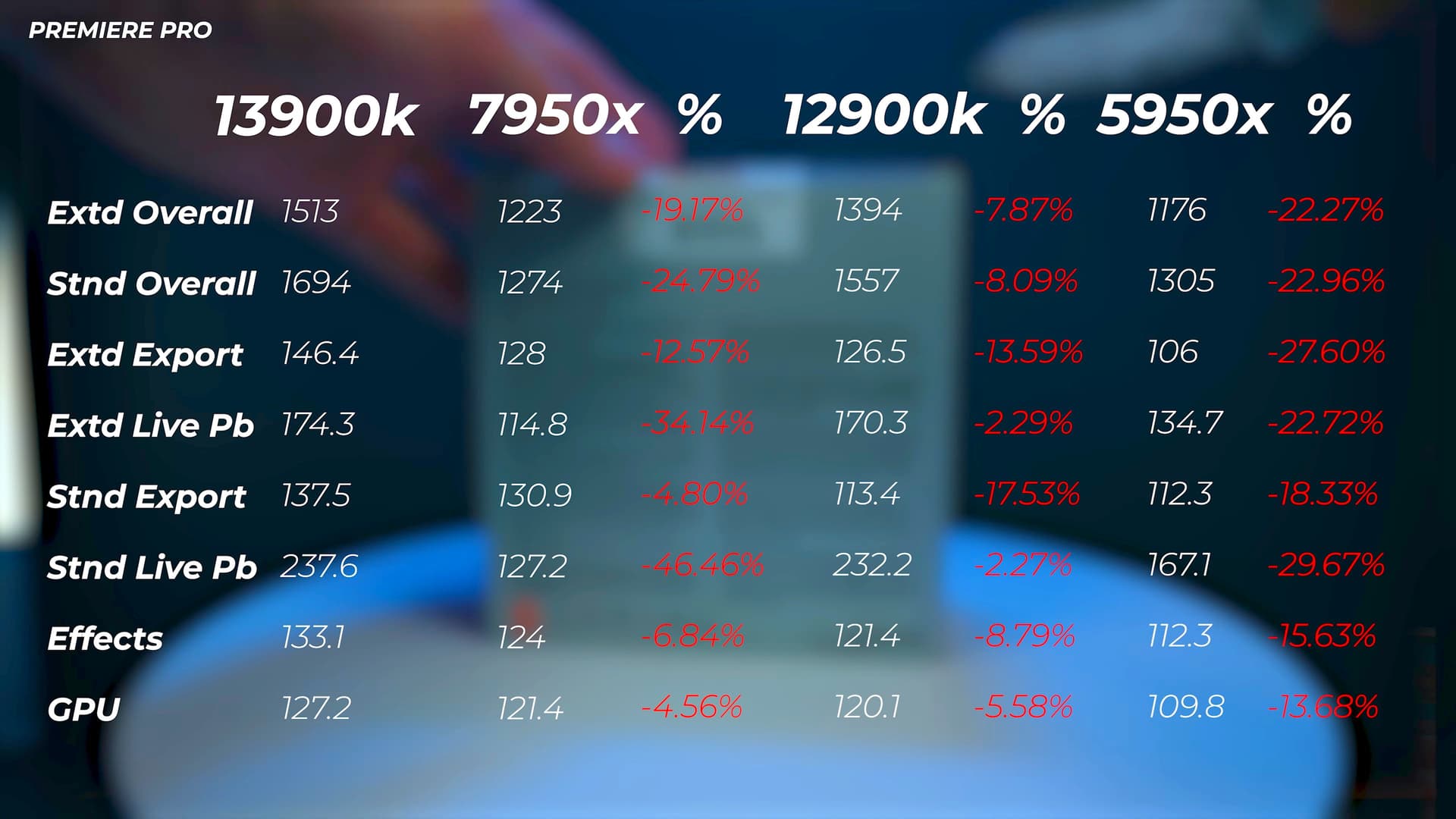
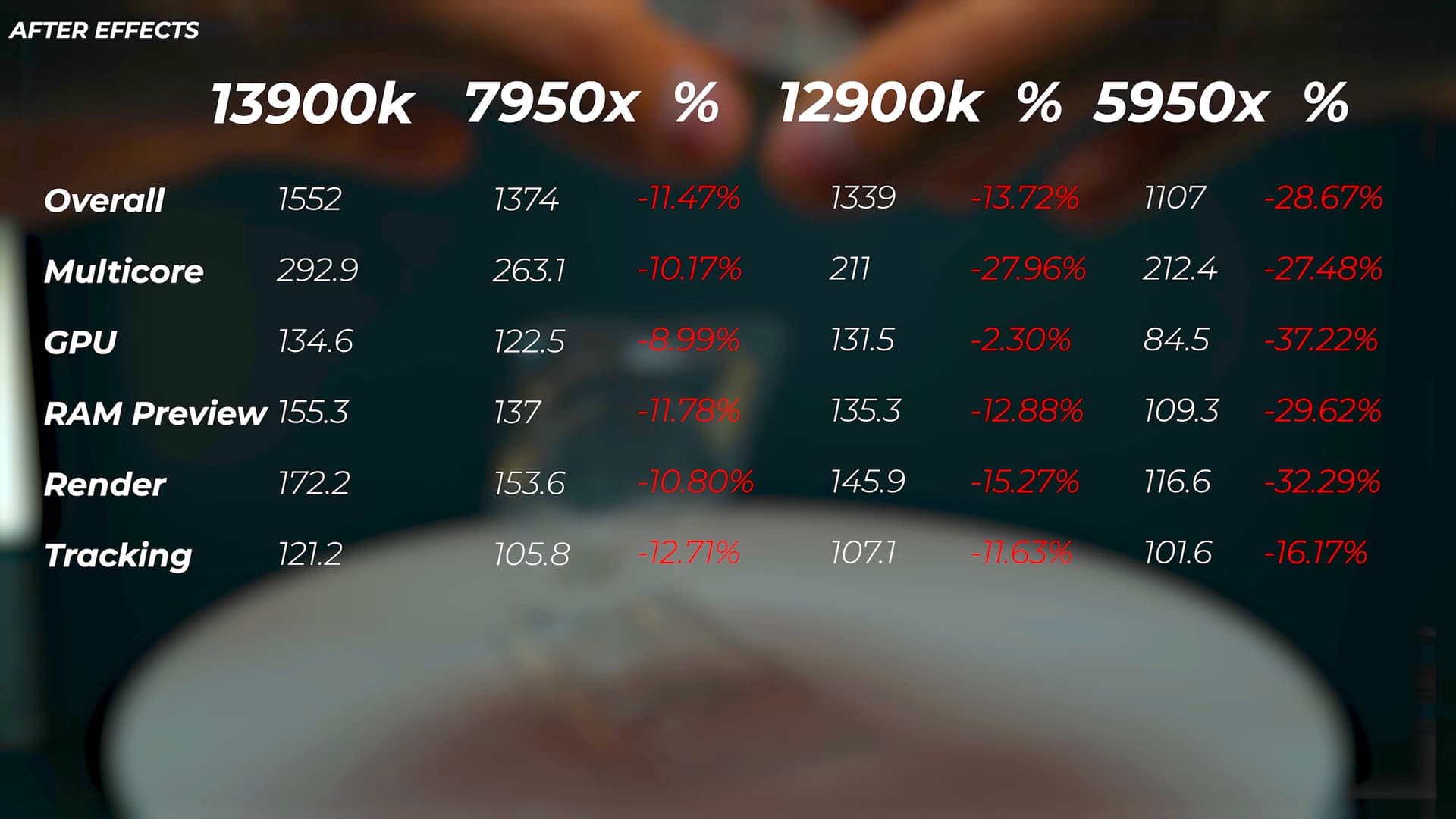
The only regret I have from my 7900X is that it takes about a full minute to start up, because of memory training. Over all I like that there’s no clear winner in all categories between Intel and AMD right now.
1 Like
