Here is another new photo from my series on roes deer. In this one, they are running.
2 roes running - Imgsli
Lots of motion blur to decide on in that one !
I like the picture because both roe deer are captured running and nicely (additionally) focused. But it still seems a bit unusual to me, as if the camera is following the running deer, so the background and ground are blurred by movement (I’m not saying that’s bad at all, on the contrary, it’s better here to have the deer in focus than the grass). Something like a video shot. I usually have it the other way around: blurred deer (or birds, etc.) and a solid background around them (which is worse and more difficult to fix). If I get a good shot, everything (subject plus surroundings) is not blurred, and vice versa. It depends a lot on the ability to follow the subject’s movement with the camera movement. Maybe the deer’s surroundings were deliberately blurred by movement afterwards, to emphasize the fast running? Or was it the opposite due to the camera movement? I can’t tell from the original. In any case, it’s a nice shot  .
.
 .
.In any case, it’s a nice shot
Thanks 
Here’s my second to last photo in my series.
2 roes running. - Imgsli
Although it’s the last one from 2 weeks ago hahaha. I have another one from 2-3 days ago that I’ll show soon.
As usual, nice result and beautiful roe deer. Interesting how in the original some of the legs are “translucent” (right front legs), but the final result is perfect. The darker background of the final photo looks very favorable. 
Thanks  . Yes, the translucent effect, as you say, is due to the rapid movement
  . I think I’ve done a good job of restoring it. But it’s not as easy to do it exactly the same
  .
.
Yeah for the darker background, I redid it because on the original there is a part of the blur of the red brick of the facade of my house. Because I was really against my window on the edge where there was the brick. I managed to correct that +/- less correctly.
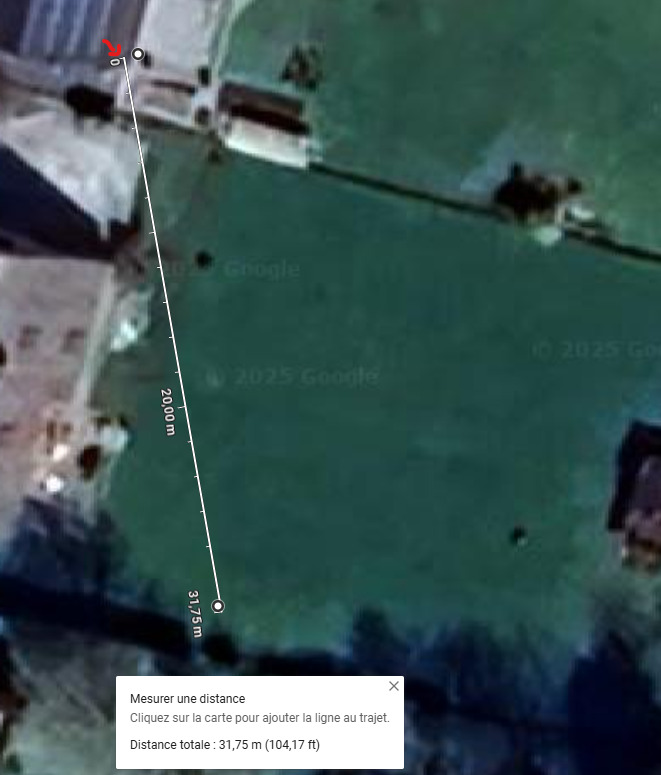
This is more or less the shooting angle and distance. 
And here is my last roe deer photo. Another magnificent photo rich in detail, very well captured.
Roe - Imgsli
Again, your high standard, I like it. Furthermore, I would like to highlight the spatial (3D) appearance of the picture, given by the “sharp” deer, the bush behind it and the already familiar background.
The various programs have made quite a difference! A thought occured to me while reading this thread: is it still reasonable to use language such as “recovering detail” or “restoring a photo” when we are allowing software to modify so drastically a source photo? Being that neither of those phrases is a valid descriptor of the actual modifications being made, as the concepts of “revealing/rescuing something previously present” (i.e. the meaning of the language in question) and “replacing something previously present with something new” (i.e. the actual process occurring) are almost opposites. As we continue to make strides towards the eventual nullification of photography, and the concept of a photo as a captured snapshot of a real moment disappears along with it, should we not be freeing ourselves from the limiting meaning of photograph and associated terms? I accept that retaining some element of the photograph is currently necessary and sufficient to hide the computer-generated nature of images from the viewers we want to use our images on, but at some point it must become pointless to continue all the little references to photography we use to disguise our activity, no?
If I may add something to this, purely subjectively: I think your view of the matter is completely correct, including the linguistic point of view. Edited (enhanced) photos do not show exactly what was photographed. But neither do unedited images, because neither the camera nor the eye is perfect and suffers from a number of shortcomings. There are various imaging technologies, from artistic (for example, painters) to technical and documentary (for example, special astronomical telescopes). Photos from Mars or from space are also edited to show us anything at all (focus, color, brightness, clarity, etc.). It is similar with our photos – neither the original photo, nor any edited one, shows the deer exactly as they looked at the moment the photo was taken.
For instance, “restoring details” is an artificial thing, but if it shows the fur of a deer as it usually looks like (e.g. by generalizing many observed patterns), then the question arises whether a blurry original with unclear or undisplayed details is better, or some kind of adjustment that brings the imperfect image closer to reality? It also depends on the purpose of the display – police documentation of a traffic accident is one thing, where nothing can be additionally adjusted in the photo, but obtaining an illustration of an animal just for the pleasure of the eye has another purpose. I don’t know how to express such things in linguistically appropriate terms and I don’t dare. We often don’t know the 100% perfect appearance of the photographed original, so it’s hard to say how perfect its image is. If for some reason the adjusted one is more suitable, then it’s a good idea to adjust the bad original. I think Harald’s adjustments show beautiful deer “almost as if they were alive”, so I would personally prefer them. I can’t say when the originals would be better. But as I wrote, these are just my subjective points of view, nothing more. I read your perspective with interest.
Just as an aside, sometimes I am reminded of the famous film Blow-Up (1966, directed by Michelangelo Antonioni) based on a short story. It was about “the impossibility of grasping objective truth”. An episode from the life of a professional photographer.
Also, to get a truly perfect original without AI retouching, you would need an extremely expensive camera with at least 50 megapixels and a super telephoto lens of at least 300-600 mm (what I don’t have) to get the sharpest image possible. So yes, with AI, I try to get as close as possible to that result. The most complicated part of the photos I showed was mainly the grass and preserving the small white spots on the backs of the two youngest roes deer.
And on top of that, a tripod weighing at least 20 kilos for the camera. And even an experienced professional eye would find flaws physically caused by the lens (e.g. light dispersion – the decomposition of white light into a spectrum for long focal lengths, or thermal noise of the CCD sensor). Everything is multiplied when the crop is enlarged… it’s complicated, so we pay artificial intelligence to do it for us .
Yeah it’s sure hahaha.
