DaVinci Resolve Plug-in & Aion Frame Interpolation (Q1 2024)

Davinci Resolve Plug-in

Our next plug-in release is for Davinci Resolve. We’re very excited to offer the full set of Enhancement models directly within Resolve, and we expect to see some very creative workflows using the node-based system that so many of our users rely on for color grading and visual effects.

Integration with editing software is a priority for us as we continue to see the many different ways Video AI’s models are becoming an essential component in professional-level work.


To install the beta plugin, follow these steps:

    1. Open Topaz Video AI
    1. Make sure you are signed in
    1. Click Plugins > Install Davinci Resolve Plugin

Please check out the 4.2.0 release thread for more details.


Aion Frame Interpolation

The new Aion model is capable of more accurate motion estimation for high-resolution inputs. Aion analyzes the input at multiple scales, considering the entire frame rather than strictly dividing the input into tiles, increasing overall precision.

This model is also capable of true 16x slow motion without duplicate frames.

We recommend using Aion on 4K or larger inputs, and for clips that involve motion across the majority of the frame.

The increased precision of this model will not always be necessary for every input, so we recommend comparing Apollo and Aion using the app’s Preview button to decide which model will be more efficient.
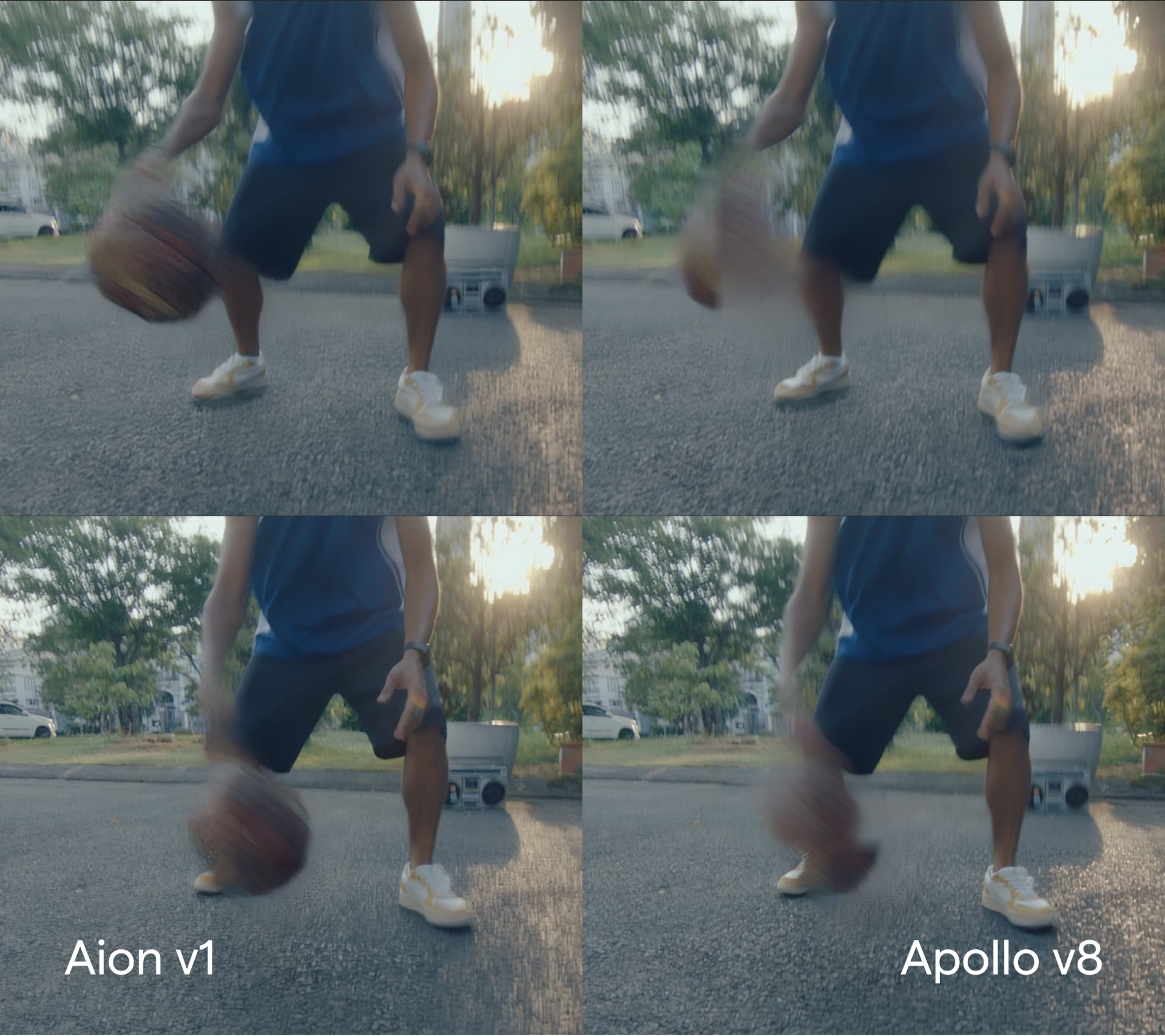
Comparison between Aion v1 (left) and Apollo v8 (right) on a 4K sample clip

Other improvements

  • The new “Low Disk Space” warning system will notify users when exports could fill the selected disk and stop processing.

  • 3D LUTs are now supported in exports, allowing users to process Log footage directly in Video AI.

Together, all of these features tie in to our overall goal of creating the smoothest possible workflow for high-end professional use cases.

What’s Next?

Upcoming releases in 2024 will include several long-requested features focused on improving the in-app experience and the reliability of Video AI:

  • Pause/Resume controls for exports, including the ability to close Video AI and reopen a Workspace to continue processing a partial export.

  • Crash Recovery: Video AI will retain exports after an app crash and allow users to pick up where the last export stopped.

  • SDR → HDR conversion: A new model will automatically expand the dynamic range of input videos for display on HDR-compatible devices.

  • Instant Previews: A new timeline design will automatically generate previews as videos are playing, and will also display the current progress of export jobs.

Please apply for the Video AI beta program if you’d like to shape the development of these features. Thanks, and we look forward to hearing what you think!

6 Likes

Exciting updates, really looking forward to the SDR > HDR conversion model!

6 Likes

Whilst this is exciting, I am waiting for pause/resume before I renew my licence. I hope it’s not too far away.

4 Likes

Do you plan to improve compute performance on AMD platforms with ROCm 6, new ONNX versions and Ryzen AI / XDNA?

4 Likes

@tony.topazlabs NO TVAI v5 roadmap update??? :disappointed_relieved:

3 Likes

Just a heads up, when you click on Product Roadmap in the program itself, it does not go to the main Roadmap category, but to Dynamic Compression thread.

@tony.topazlabs @amy.mae @suraj @gregory.maddra @yuan.liang

I really hope that in the coming months, you can steadily improve the uspcaling models in TVAI, as the competition is making great strides… look at the web page examples of the new model for video that will surely come in Adobe products:

:sweat_smile:

2 Likes

I wouldn’t be so sure that Adobe will implement VideoGigaGan in Premiere Pro or After Effects. If you look at their earlier project for upscaling photos called GigaGan, you can find projects on GitHub, but it seems like “fake open source” because there are no trained models available for download. Additionally, neither Photoshop nor Lightroom has received this feature even though a considerable amount of time has passed. Photoshop has the Super-Resolution neural filter, but besides being extremely slow, it cannot compare to the capabilities of Gigapixel. Camera Raw has an enhance filter for 2x upscale, but it is not the most ideal solution either, as it is practically the same as On1 Genuine Fractals, which could be considered outdated technology. If Adobe adds GigaGan and VideoGigaGAN to their products, they would certainly be more interesting. In any case, it is always better when there is competition, where they would compete with each other in terms of innovation. I have also tried MTI – Samsung UpRes in the MTI Cortex application, and Topaz Video AI is drastically better in my opinion. In combination with Hybrid where I denoise video with SCUNET while adding slight sharpness in the sharpen filter, Topaz Video AI is a perfect hit for upscaling.

nearing time for a new roadmap update?

3 Likes

Any news on the SDR to HDR conversion? Alpha testers needed :slight_smile: ?

1 Like

Hi. Do you have plans on the roadmap for an Adobe Premiere plugins?

1 Like

I would love another roadmap update soon if possible, it’s been a while now.
How is the SDR → HDR conversion coming along this is one of the features I am most looking forward to testing.

2 Likes

This sound great of course. Unfortunately I stopped upgrading because of my frustrations about the UX/UI experience.

I applaud Topaz for having an active forum and engaging customers. As detailed as communication is, I never read anything here from Topaz that addresses the ongoing complaints about the ever changing interface. Why Topaz doesn’t get something as basic and vital as the application interface and workflow right first, then leave it because it works? There should be no reason for this many changes when the user experience and interface is just good enough. It’s changing so often that Topaz must also not be happy with how it is. Otherwise why change it up every single time?

I specifically mean change, not add. Usually things are added on and the application steadily grows. Video AI moves around and renames. It’s giving an unfinished vibe, still figuring it out how it should work and behave, at version 5.

The odd terminology for features that have been around in this industry always. For instance a module where you send your files to be rendered to, is called a Render Queue. It’s always been like this everywhere. Why call it Exports? Specifically plural, it refers to rendered, exported, done files.
For consumers having their first experience with processing video digitally this is fine. For me, working with photo and video applications for 20 years Video AI is confusing. Many things in this application (to me) sort of make no sense. It’s fine to be unique, but please do it well. 2.6.4 was weird but fine. It didn’t have a factory program going through downloading model, loading model, etc (when nothing is downloaded), taking valuable seconds every time. It had 4 screen preview comparison, rendered previews instantly and fast. What happened?

3 Likes

Hello - love the product, but curious now that the entire 1H is over and the last roadmap posting I have seen is dated (Q1 2024). What is going on with the rest of 2024? Can we please get a Q3/Q4 Roadmap with specifics?

If I’ve missed it on this forum, please link it/tag it!

1 Like