Oups error - Broken pipe. The program and the compiler didn’t account for the fact that my test machine lacks AVX2 support. I’ll be an observer for the time being.
Could you tell me which CPU generation you’re using, and which codec it’s showing?
I also noticed that a broken pipe error can occur with Rigaya’s NVEncC (v9.23). He is now using a non-static executable (meaning it relies on companion DLLs), and the updater wasn’t handling this correctly until I patched it yesterday.
CPU Intel Core I7-3770K 3.50GHz
Error AV2 coder avmenc.exe v1.0.0.40
PS Whith NVEncC64 v9.23 everything fine …i chust tem dounload and put all nessesary lib onto the same dir day before.
Regarding NVEncC version 9.23, you handled the issue correctly. Chromaster 2.8.1 will extract these DLLs into the dependencies folder. I do not know whether Rigaya will change this behavior in the future. Either way, I will keep monitoring the topic as long as an H.266 codec is involved.
As for the AV2 codec, I will compile two builds: a SIMD build and a generic build, both automatically unpacked by the wizard.
The team behind avmenc is adding AVX2 and AVX-512 optimizations, but I am not sure the fallback paths are fully implemented yet.
Chromaster will detect the CPU and use the most appropriate build, which means the generic one in your case.
Incoming …
CIE 1976 u’v’ color space
True gammut supported by your display (EDID source)
eg : here more than BT.709 but less than BT.2020, Viewsonic VA3820C
→ Gives your true estimation of color rendering
HWiNFO init: process=0 sm=0
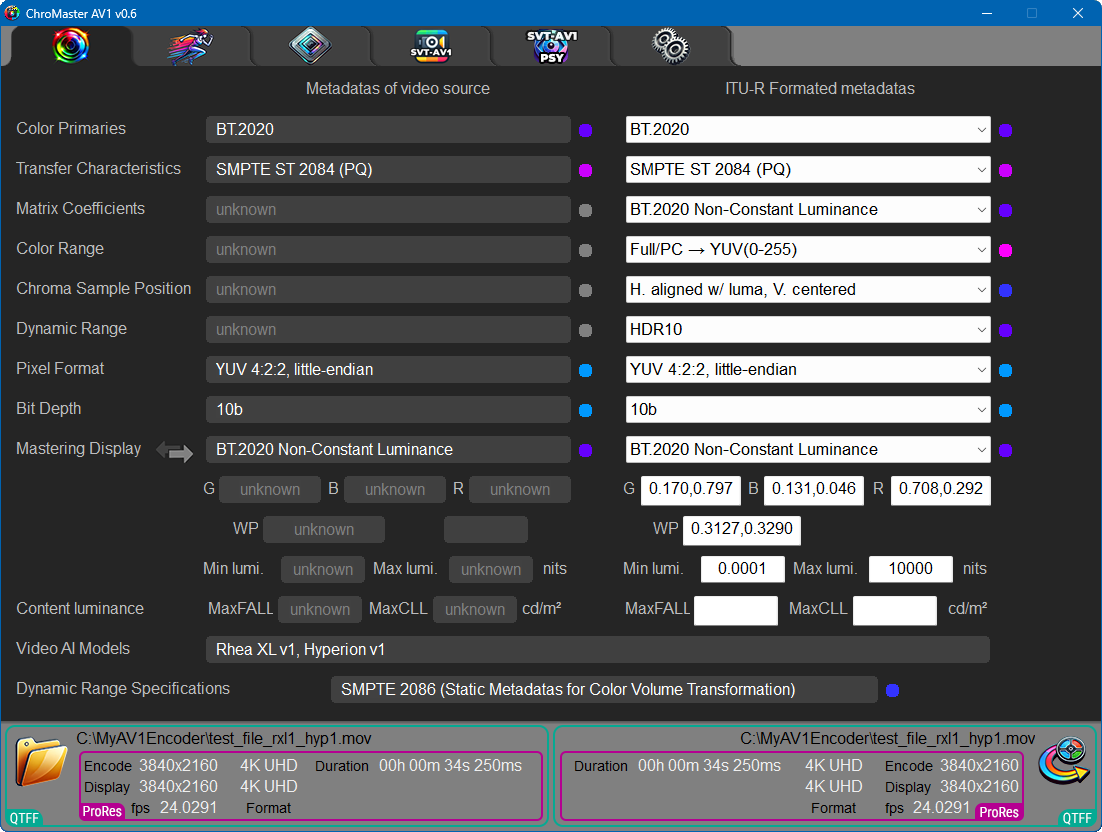
Encode [yuv4mpegpipe @ 00000000001a2a80] Warning: generating non standard YUV stream. Mjpegtools will not work.
Encode Left chroma sample position only supported for 420mpeg2 input
Encode Fatal: Unsupported Y4M stream.
Encode [vost#0:0/wrapped_avframe @ 00000000001a5240] Error submitting a packet to the muxer: Broken pipe
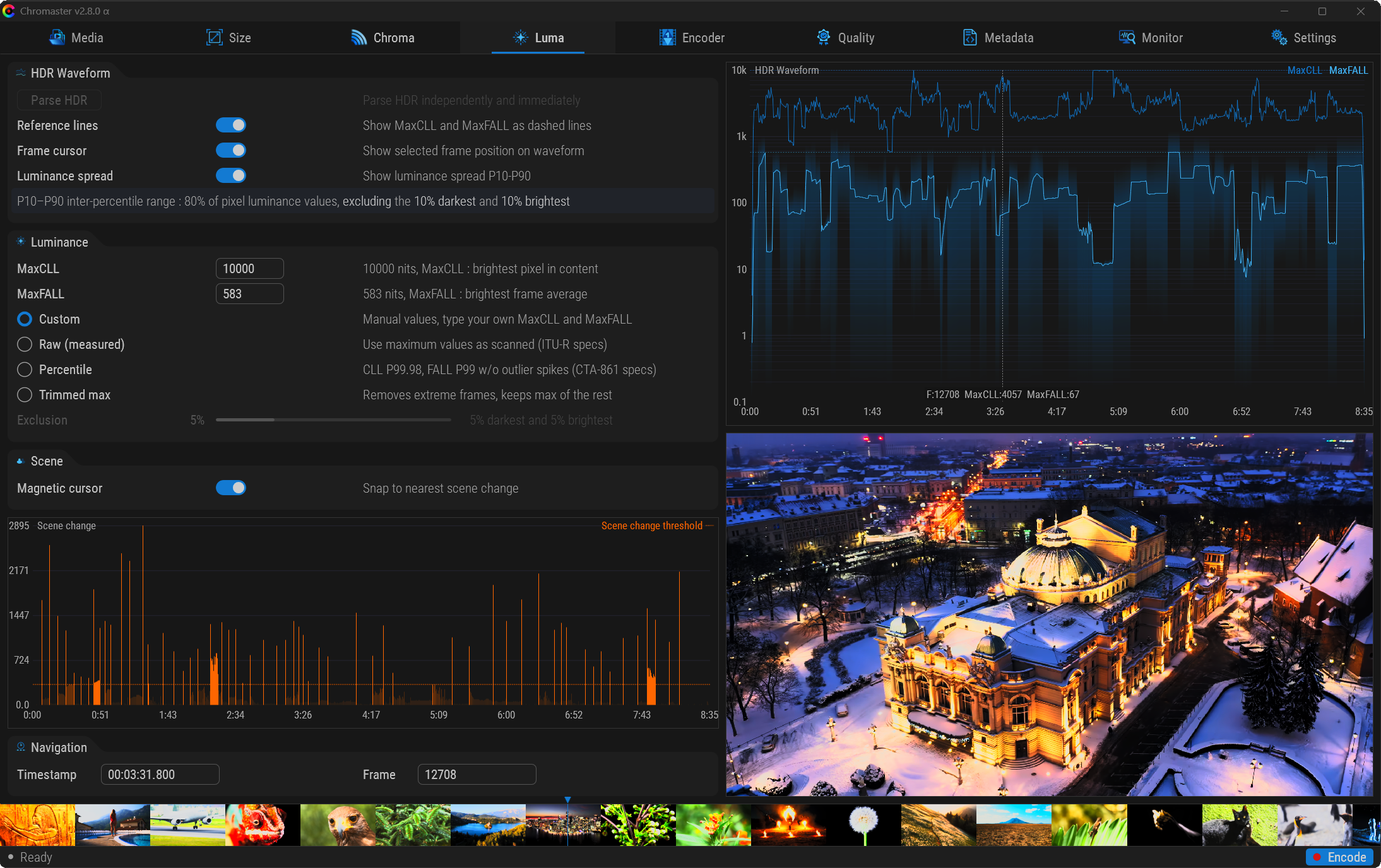
Another round on the Chroma & Luma tabs, all about pushing the colorimetry scopes into true HDR.
Chromaster v2.8.2 α
Saturation & Waveform scopes in HDR
Both analytical scopes now render their colorimetric content — smoke and curve — in linear scRGB FP16 on HDR displays, so they actually pop instead of sitting flat in the SDR range.
Yes I did, as I said
Nice content, I will definitely keep it in mind. For now, I have to schedule things so they run while I am sleeping, using my local AI. (audits, security checks and so on)
It’s hard to keep up with the rhythm alone as things are getting more and more complicated
I completely agree with the principle, and you’re also right about the numbering rules.
You can tell you’re an expert who learned coding rules in school; I understand, I went through the same thing.
Except… Chromaster version v1 really exists; I have it on my computer, it’s awful, slow, and above all, completely hand-coded, resulting in a legendary waste of time.
I’ve wrecked a lot of libraries in the meantime, and here’s what I’ve managed to recompile for fun.
Then I put “alpha” because I’m clearly speedrunning development. The “alpha” is mainly to say, “Don’t yell at me if things go wrong here or there; I’m not DaVinci Studio.”
As for the numbering, MKVToolNix is at version v100, so I’m allowing myself a little leeway too.
Less flashy than last time, more solid under the hood: the thumbnail strip goes fully HDR-aware, and a big cleanup pass hunted down latent bugs and duplicated plumbing.
Chromaster v2.8.3 α
HDR thumbnail strip
The strip finally handles HDR sources instead of clipping them to a washed-out mess.
Tone-mapped thumbnails — HDR highlights rolled off with a mobius curve in linear light; no more blown-out skies, the blue stays blue.
Multi-source aware — PQ, HLG and mistagged HDR sources are all recognized and linearized from their real transfer curve, not just PQ.
Live SDR/HDR switching — toggling the display’s HDR mode refreshes the strip on the fly, no reload needed.
Full-chroma readback — 4:4:4 all the way through, no gratuitous chroma subsampling.
Loading spinner in HDR
Always on top — during extraction the spinner and label stay readable over any HDR preview, instead of getting drowned by a 1000-nit frame behind them.
Status bar accuracy
Correct provisional container — each codec reports its real intermediate container with a matching colour; AV1 NVENC shows its raw AV1 stream, no more misleading IVF label.
Internal hardening
Seven latent bugs squashed — input-focus tracking on the AV2 tab, script prefix matching, crop ratio crossfade, CPU-temp sanity bounds, and more quiet defects fixed.
Unified path handling — one consistent path-buffer convention across the whole app; several silent truncations on long paths eliminated.
Deduplicated plumbing — the Y4M command builder and the FP16 graph engine collapsed into single sources of truth, proven byte-for-byte by identity harnesses.
Consistent container tags — provisional-container colours now match their names across every codec.
 Chromaster v2.8.0 — HDR UI update
 HDR GUI renderer
 Safer HDR image routing
  H.266 / Metadata color classification cleanup
  HDR test hygiene
  Summary

 I’ll be an observer for the time being.

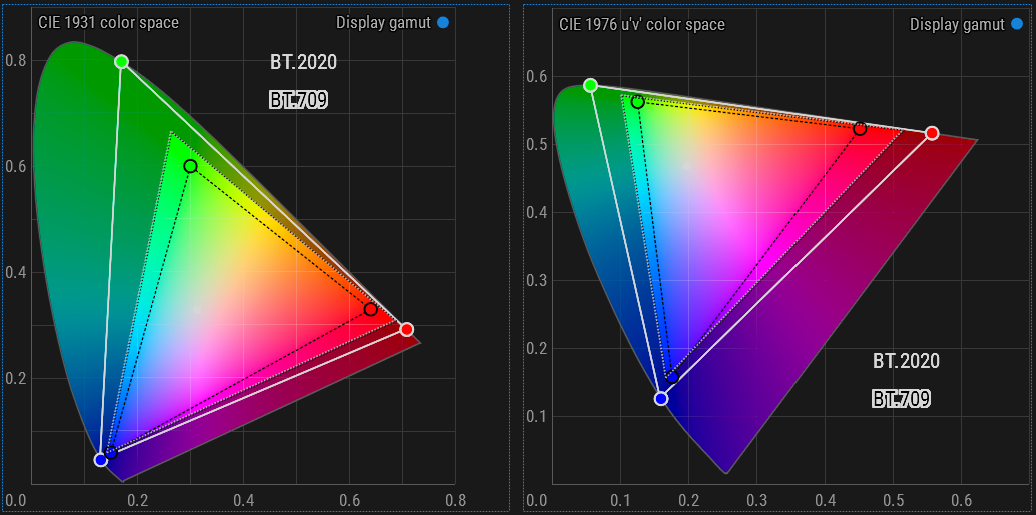


 — hidden +12.5% x-axis stretch fixed, the locus has its true shape.
 — perceptually uniform companion, same spectral data, u′v′ projection.
 — EDID primaries via DXGI, unreachable colors dimmed, multi-monitor aware.
 — margins reclaimed, titles anchored to grid corners, axis letters dropped.
 — CLI and Metadata tree share one token stream
 — clicks no longer pass through open dropdowns onto sliders underneath.
 — recent Rigaya builds are no longer static; required DLLs now deployed alongside.


 — smoke + SATAVG curve pushed beyond sRGB green, glowing above reference white.
 — log-luminance smoke rendered in extended blue, brighter than the UI white point.
 — signed-distance coverage in FP16; smooth curves, zero staircase aliasing.
 — grid, axes, labels and cursor stay crisp; only the colorimetric content goes HDR, composited underneath.
 — on SDR displays the scopes are pixel-for-pixel unchanged, proven by binary-identity harness.
 — clean grey dash matching the destination triangle, snapped exactly onto the out-of-gamut boundary.



 — HDR highlights rolled off with a mobius curve in linear light; no more blown-out skies, the blue stays blue.
 — toggling the display’s HDR mode refreshes the strip on the fly, no reload needed.
 — during extraction the spinner and label stay readable over any HDR preview, instead of getting drowned by a 1000-nit frame behind them.
 — each codec reports its real intermediate container with a matching colour; AV1 NVENC shows its raw AV1 stream, no more misleading IVF label.
 — one consistent path-buffer convention across the whole app; several silent truncations on long paths eliminated.