Yes I like it too, but just one optimized factor is not enough. As I wrote in a previously post, an additional optimized model from 480p to 1080p and to 1440 pixel in height (WQHD, many display standard) and 1080p to 4k (TV Standard), would be nice.
2 Likes
If I recall correctly, Rhea is supposed to be optimized in the 4x department so it can also downscale to the desired resolution after the 4x is applied. If I’m using the right term, this is similar to super sampling antialiasing.
3 Likes
You are correct. There are other major down-sides to that though.
With a standard DVD and upscaling it to FHD as an example. Going up to near 4K and than down to FHD makes the result much more plastic-like, and it takes more than double the processing time. Now, the plastic-like look is mainly noticed on skin, and maybe Topaz has accounted for that in the Rhea models. Proteus and Artemis suffer from this though.
The same issues are present if you want to do FHD to 4K. Only having a 4X version of the model means it will upscale to 8K taking loads of extra time.
2 Likes
For me, the processing time isn’t as much of a concern because I tend to run Video AI when I am either away from keyboard or working on some other tasks. However, I do see the poor results on the Proteus and Artemis models as well. These models are in desperate need of an update, but the current roadmap appears to be about making new models more than updating our current ones.
1 Like
My biggest problem with any 4X scale model, is that I find 4K to be useless from a realistic technology stand-point.
My computer monitor is a 24 inch FHD display and sits ~2.5 feet away from my face. To replace it with a 4K monitor, it would need to: Have the same pixel density and be 4X the size, or have a higher pixel density, but enlarge all text and UI elements to match the FHD sizes—so basically forcing it to display in FHD. I don’t want it physically bigger, so that I can see everything without moving my head. I cannot move it farther back on my desk to be able to see more of it at a time. And if I could, it would make the text smaller, so I would need to enlarge it. It all circles back to 24 inch FHD being the most optimal for me.
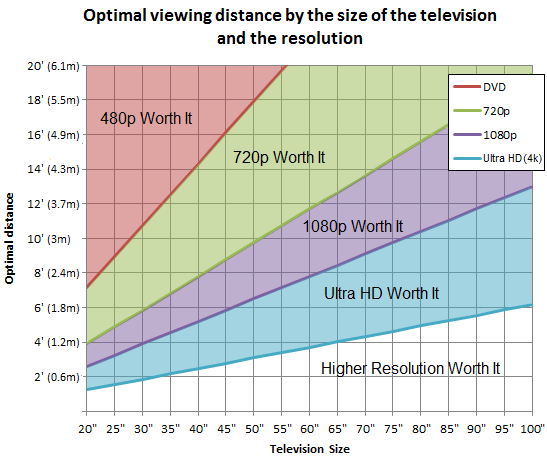
Well how about a 4K TV screen then? Still useless. I have a 50 inch FHD screen and it sits about 12 feet away from my face. It’s probably a little too far away. Modern videos in FHD often make the credits on-the-border-of-being too small to read from that distance. Anyway, I cannot make out individual pixels from that distance. Increasing the pixel density to make it 4K will visually do nothing. In fact, optimal viewing distance charts, like this one [From rtings], say I would need to get a screen bigger than 90 inches to for 4K to start being worth it. And that’s not something I can do now—nor in the foreseeable future.
you’re right and as I wrote two times, for me 4x upscaling should stay, but we need at least one other optimized upscale factor too. I don’t want upscales 1080p to 8k and store this monster files on my NAS and then play it on my 4k OLED TV which has 3840x2160 resolution. Sorry this makes no sense I create native pixel content for my TV. If I upscale 480p content 4x, it gives me 1920 vertical pixels, but this is not 4k and not WQHD, my monitor has 1440 vertical pixels
When they say that it would be too time-consuming to additionally train such a model, you could downscale it with third party software using Lanczos, then I say why Topaz can’t do that for me, when Topaz do downscale, it’s nonsense to enhance the enhanced again, just downscale, here is doing less better.
What would you all like to see for the 2025 Roadmap? Since we are getting towards the end of 2024, I thought we could discuss some things here.
2 Likes
Support for equirectangular and fisheye projection for 180/360 3D video is of utmost importance, especially since there will be an increased demand for immersive content over the coming years with hi-res consumer headsets like the Vison Pro slowly gaining traction.
2 Likes
Although I do not work with this video myself, I would still like to see this emerge as well.
Remember how 3D was going to be the most important advancement in video technology back in like 2007?
Did it turn out to be true?
How sure are you that VR headsets are going to become more common place than standard TV screens?
There’s a lot of investment in the immersive content space due to the emergence of better headsets and improvements in the display tech. Not to mention Apple is investing heavily as well, which can move the market. Furthermore, more flexible ai models that can account for exotic image projections and wide lenses used in immersive content also helps make the models better even for flat content which often uses special lenses and distorting effects - having robust models makes the product better and more reliable for everyone.
There was a lot of investment in 3D back then too. It didn’t change the usefulness to the public and the overall need and desire for it.
I love surround sound more than what is reasonable, but the general public today spends their money on sound bars way more than surround sound systems. 3D TV systems, well, no one bought them much after the initial hype.
All the opinions I have heard, from all the strongest Apple fans, have said the headset is a cool idea, but it’s not for them—Not something they would go out of their way to buy.
I agree that such models could be useful, and maybe help improve unexpected areas of TVAI. From a investment standpoint though, it’s a gamble.
look at it this way - there are only advantages to supporting more lens and image projections. these have been around for well over a decade already and aren’t going away. just because you don’t see a use case doesn’t mean lots of other people can’t benefit.
Hello.
Yeah… but no!
https://www.extremetech.com/electronics/report-apple-vision-pro-flops-with-less-than-100000-sales
There are oodles of articles that states the opposite of your claim, unfortunately.
It seems like investing in the Vision Pro would be like driving a Bugatti Chiron in the Saharan Desert.
You do realize immersive video isn’t ONLY for the vision pro?
And that others may have different use cases than you do? 90% of my professional work is immersive. it’s a massive miss in the current video ai models to not support this.
It’s not about me, it’s simple fact-checking.
You are warranted to have YOUR support for VP, ect. but the numbers don’t lie. Just research for yourself… honestly. You are giving A LOT OF YOU but nothing to back-up these claims. 
I’m probably not the first one to ask for this, but with all the hype around the new Apple silicon chips would it be a good time for you to optimize processing and use their potential?
1 Like
I’m still waiting for an improved deinterlacer.
3 Likes
I hope Rhea 4x upscaling does a little more than just ‘super sampling antialiasing’ (for reduction x4 again).
Problem with upscaling beyond 4x, is that you also multiply the errors. That is why trying to upscale a 320p vid to 8k, for instance, is utterly pointless. Even if you did it in multiple steps. That is what I call ‘Pokemon economics.’  Ever seen Jessie and James reason their get-rich schemes? Like “First I’m going to upscale to 640p, then to 1080p, then to 4k, then to 8k. Ka-Ching!” That is not how it works, of course, as the distortions you create in an early pass only get multiplied each step along the way.
And 8k? Can’t imagine me ever needing 8k. Then again, there was also a man who once said “640K ought to be enough for anybody!”  So, who knows.
I have zero use for 4K. In case you missed it.
I understand the marketing stance of “bigger number = better”, but the more I try to justify 4K, the more illogical it is for me. Please understand, I have tried bigger monitors with bigger resolutions. They make me want smaller, with more reasonable, resolutions every time.
2 Likes