Unlimited Cloud Rendering services are subject to usage limits, queue depth
restrictions, time-based throttles, and availability and hardware restrictions at Topaz
Lab’s discretion. Topaz Labs may revoke your access to Unlimited Cloud Rendering
for any reason including behaviour considered malicious, abusive use, or otherwise in
breach of the EULA
Actually, I had read both the pre-Sept 16, 2025 EULA and post-Sept 16, 2025 EULA. But that detail slipped my mind.
At the moment, I am focused on one of decisions I made on Sept 13. Once I learned from AND-E that the monthly 300 credits we receive under Founder status, and I realized any project might use for credit were likely for video, were I signed up for a subscription for 1,400 credits.
I did this for several reasons:
1.) My project(s) upscale 1 hour videos to 1920x1080
2) I would need more than 300 months.
3.) If I didn’t know the post Sept 16 price would be for buying credits.
I use 832 credits for an hour 1280 x 720 video upscale. It worked just fine.
After a few short test, I was left with 565 point.
There was nothing I could do with that number. And I had planned for that. Knowing I would get another 300 credit, I could add that to the 565, and get 865, just enough to get one more 1 hour video upscaled.
All has been going according to plan, except for one thing. Knowing I just had the one more project, I cancelled the monthly subscription, know it would expire on Oct 10, 2025, but believing that on Sept 16, my credits would go up by 300 to 865.
But that didn’t happen. First, I thought I would get then on Spet 16. Then I read I would be transitioned in 5 days. I thought, OK. That’s Sept 21.
Now, my window to use those 565 credits is getting tighter and tighter. And I am a bit frustrated.
In the first one he has clearly stated Founders get everything with two applications and Topaz Video comes with all the Starlight Models and in the second he stating clearly people have called their Licences because, of his recommendations
In the first one you are stating You will also get legacy access to the Starlight series of models and in the second one you are stating Founder status is per-app, so you’ll get founder status for the perpetual licenses
Please clarify as it appears you are contradicting yourself or am I missing something
It would sound correct and consistent if slightly re-worded:
“The only difference will be Legacy status is per-app, so you’ll get Legacy status for the perpetual licenses that you hold. (and of course, the ability to run the old apps if you have a perpetual license)”
Since perpetual license are pre-Sept 16, 2025, and Founder status is a post-Sept 16 concept.
On the other hand, if you have an active license for any number of pre-Sept 16 products you have Founder status by definition. And that licensing is per-app and perpetual. All other benefits of Founder status are subscription based and end when the payments of $163/yr stop.
On the the other hand, there must be many, many licensee whose renewal period has expired. If the renewal period for all products have expired they are do not have Founder status, but they still have a perpetual license.
It did not have to be that way. Macrium Reflect v8 had periodic upgrades with a lifetime license to use all prior version. They switched to the subscription model. And you were given a choice: a) do NOT subscript to Macrium v10, keep your lifetime license to use v8 and earlier, but receive no support, upgrades, updates or maintenance releases, or b) pay the annual subscription for v10 and agree that your lifetime license to use all prior versions of Macrium reflect are void and null.
A curious transition strategy by Paramount Software UK Ltd, the makers of Macrium Reflect.
All I am saying here is…based on the Macrium example, we see paying a subscription fee for the next version of software could make the lifetime license to use all earlier versions of that software null and void. Topaz Labs, LLC decided not to do that.
These days companies are demonstrating their creativity in coming different ways to navigate the lifetime license → subscription model transition.
Paramount Software UK Ltd did this:
Announcement: September 18, 2024, announced the upcoming shift to a subscription model
Final perpetual sales (Version 8): Sales of perpetual licenses for Macrium Reflect Version 8 ended on April 1, 2025.
Subscription launch (Version X): coincided with release of subscription only Macrium Reflect X
You could buy into the subscription model and lose your rights to a lifetime license to use the earlier versions.
Or, not buy the subscription, and be “stuck” with a lifetime license to use the legacy software with no support.
A difference is Paramount Software UK Ltd provided a 6 month windows to buy what would become a legacy product by April 1, 2025.
Providing 6 months to the users to process the decision was a kindness. In our present case having 11 days to make a decision was a tad like high pressure sales tactics. It was stressful, traumatic, and a “rug pull”.
Others will say, yes, but…there are aspects of Topaz Labs, LLC’s approach that was more fair. The offer on the table was: you keep your legacy product no matter what (buy the subscription or not) and you get locked in prices and a variety of perks beyond the what any combination of legacy products provided at a price lower than the legacy products it replaces.
Adobe took a phased approach over 2 years.
Adobe announced its shift to a subscription-only model for Creative Cloud on May 6, 2013, at the Adobe Max conference.
Full discontinuation of perpetual licenses was completed by 2015, finalizing the transition.
Neither Paramount Software UK Ltd nor Abode engaged in a rug pull, both accomplished the same goal: a 100% transition to the subscription model.
The difference here is 11 days versus 6 months or 2 years.
I don’t think it was the transition to subscription that has stirred some in the user population so much as the speed with which it was implemented. And, with no chance to evaluate what the new offering would look like. Some of us, myself included, still don’t know what the full offering will look like at it is a week later.
A week is too fast for a transition of this magnitude, all will agree.
That’s why in each of my two other examples the transition was run in parallel for 6 to 24 months.
There are a variety of way to do systems migration:
Parallel running: Both the old and new systems are run simultaneously for a period of time to ensure the new system works correctly before the legacy system is fully retired.
Phased conversion: The new system is introduced in stages.. This is a gradual approach that helps minimize risk.
Pilot conversion: The new system is first deployed to a limited area, such as a single product, to test it before a full rollout
Adobe and Paramount chose to run two systems is parallel.
Topaz Labs, LLC chose a fourth method:
Big bang (or direct cut-over): The old system is completely and immediately replaced by the new one on a specific date. This is riskier but often faster.
I can’t know this, but I would surmise that protecting downstream revenue was the main reason for preferring the Big Bang approach.
If it was know that Topaz was going to a subscription model, and the now-legacy apps continued to receive the normal flow of support, update and upgrades, there would be a sizable portion of the current user population (self-selected to graviate toward lifetime license and away from subscription models) that would “game the system” by renewing for as long as the upgrades and updates were forthcoming, with the premeditate plan to abandon Topaz Labs, LLC once the lifetime licenses were no longer on offer. Furthermore, by continuing to update and upgrade the lifetime licensed software, Topaz Labs, LLC would be digging their own revenue drought. The switch to subscription would have a precipitous drop in revenue, and only new innovations could bring new users into the fold. But Topaz would have “given” away 4 to 8 months of hard world refining beta and coming up with new models and features during the Parallel Running period. Making is doubly hard to keep existing users or pull in new ones.
By doing the Direct Cut-Over, the previously withheld development effort on new models and refining existing beta could be rolled into the new subscription model, given both the incentive for prior lifetime licensee to “bite the bullet” and signup for the subscription. But also the new models anounce coincident with the subscription model was good for attracting new users – themselves not “spoiled” with a lifetime licensing model.
Parallel running doesn’t offer the speed of the Direct cut-over. The world has become increasing competitve in the image processing world. Speed may be the only survival strategy that will work. If speed can be combined with a more stable recurring revenue model. the chances of survival are improved.
What I don’t understand is why the Direct Cut-Over needed to be just 11 days.
Knowing that the Lifetime, Legacy applications would never be for sale again, would be itself a reason for some to buy. And this is without any further improvements after the Sept 5/16/26 cutoff.
For example, I did a quick calculation. While I could learn DaVinici and convert a 1280x720 video to 4K, I had to ask, “With only two 1-hour videos to convert did I really want to invest the time?”
And yet, to get to 1920x1080 was 832 credits, and to upscale to 4k was 3,304 credits. And I had two such videos to upscale. So that would be 6,608 credits. And no help from the Founder credits at 300 credits a month, use it or lose it.
So, just price the 6,608 credits versus the cost of TVAI.
At 1,400 credits for $99 (just as one example) that would be 5 x $99, or $495.
I bought the 1,400 credits because I don’t have and am not planning to buy a GPU. I have only ever run Topaz products on my PC. So, I thought I was SOL and would need to run all upscaling on the cloud. So I settled for 1920x1080. It was only later I discovered my Mac Mini M4 16GB not only could upscale to 1920x1080, but also 4k. That is when I realized I could cost justify buying TVAI, even as a “dead” product on Sept 13 – knowing it would never get an upgrade, but also knowing I have no learning curve, and it just worked. It took over night, but it worked.
Buying TVAI for $299 for TVAI would be a cost savings of $196 over buying point (5 x 1400 credits/$99 = $495 ).
No expectation of upgrade or updates. And still a viable choice for a few.
So, why shut down the sale of lifetime licenses so quickly? Neither Adobe nor Paramount saw the need. I am not completely sure. Maybe there is a theory out there.
Someone could do a PhD just on the path that companies followed in the last 15 years as they simultaneous did a user migration and a systems transition from local, lifetime licenses to cloud, subscriptions. Billions of dollars of cloud infrastructure by Amazon, Google, Microsoft and Oracle made it possible.
Macrium and Abode avoided the risky systems transition of the Direct Cut-Off. We still don’t know how that story ends.
I picked a new screen name to reflect a a special optical property of the Topaz gemstone.
All topaz are inherently pleochroic to varying degrees. That is, their crystalline structure interacts with light to causes different colors to appear from different angles. The specific colors depend on the type of topaz and the angle of the incident light. This property is called pleochroism.
I believe that Topaz Lab, LLC has simliar properties. It takes on a different look when looked at from different angles. And like its namesake, this can be a very attractive feature, enhancing its value greatly.
For example, the Imperial Topaz represents less than 0.5% of all Topaz found. It is the most sought after Topaz, and is highly prized. One of the two colors it displays is a ruby red. The stone must show a reddish pleochroic color to be called Imperial Topaz.
My reason to mention this off-topic, is to bring the metaphor back and say, what Topaz Labs, LLC has done to-date has good and bad characteristics; like the Imperial Topaz, depending on the angle of incident light it will look different.
Using the average of the licensing transition of Paramount’s 6 months and Adobe’s 2 years, we can say using an industry average, we are missing out on is 1 year’s worth of update and upgrades. And even then, with our expiring license would have meant either: a) we would have needed to top up our current renewal on a monthly basis to bring it up to 12 months, or b) the user population would have entitled to the average remaining active license of six months (assuming licenses were issued evenly across the month, which we know with Black Friday sales, isn’t the case, but OK for a first approximation).
One way to have cleaned that up was to offer all user the opportunity to extent their legacy license until Sept 16, 2026, by which point there would be one last upgrade to the legacy software apps. Have an active license on 9/16/2026 get one more update to the legacy app. Fall short of that date, and what you have is what you keep.
The Direct Cut-Off approach to the systems migration and to the lifetime license → subscription model:
invited unnecessary stress on the support function of Topaz,
caused the IT function to go into overdrive with unrealistic deadline that already have not been met (the so-called “5-day” transition,
cause excess and avoidable negative sentiment among the current users,
might has nixed a selling opportunity for the “dead legacy” software that could have had value for current users that lacked that application, or new users wanting to first “buy and try” the legacy software as they looked at the Studio application.
The Run Parallel approach has its detractors and its supporters. Going to it are:
lower risk to systems transition, you always have a fall back while implementing the new system
the Support function can transition over from what they know to what they need to know is a more gradual fashion.
user know and have known the shift to subscription was coming, its arrival was not a suprise. The speed of implementation, the short 11 day period to make a decision, and getting the pitch without seeing the goods involved an act of trust on the users part, an attribute depleted by that speed with which change was thrust on them. It felt high pressure.
there was a very real opporunity to run out the clock by selling a legacy application either: as it, or with one last round of improvements in 12 months time, for which to qualify every would need to “level up” their active license to reach Sept 16, 2025.
Like a topaz, it can take on a different shade depending on the angle you look at it.
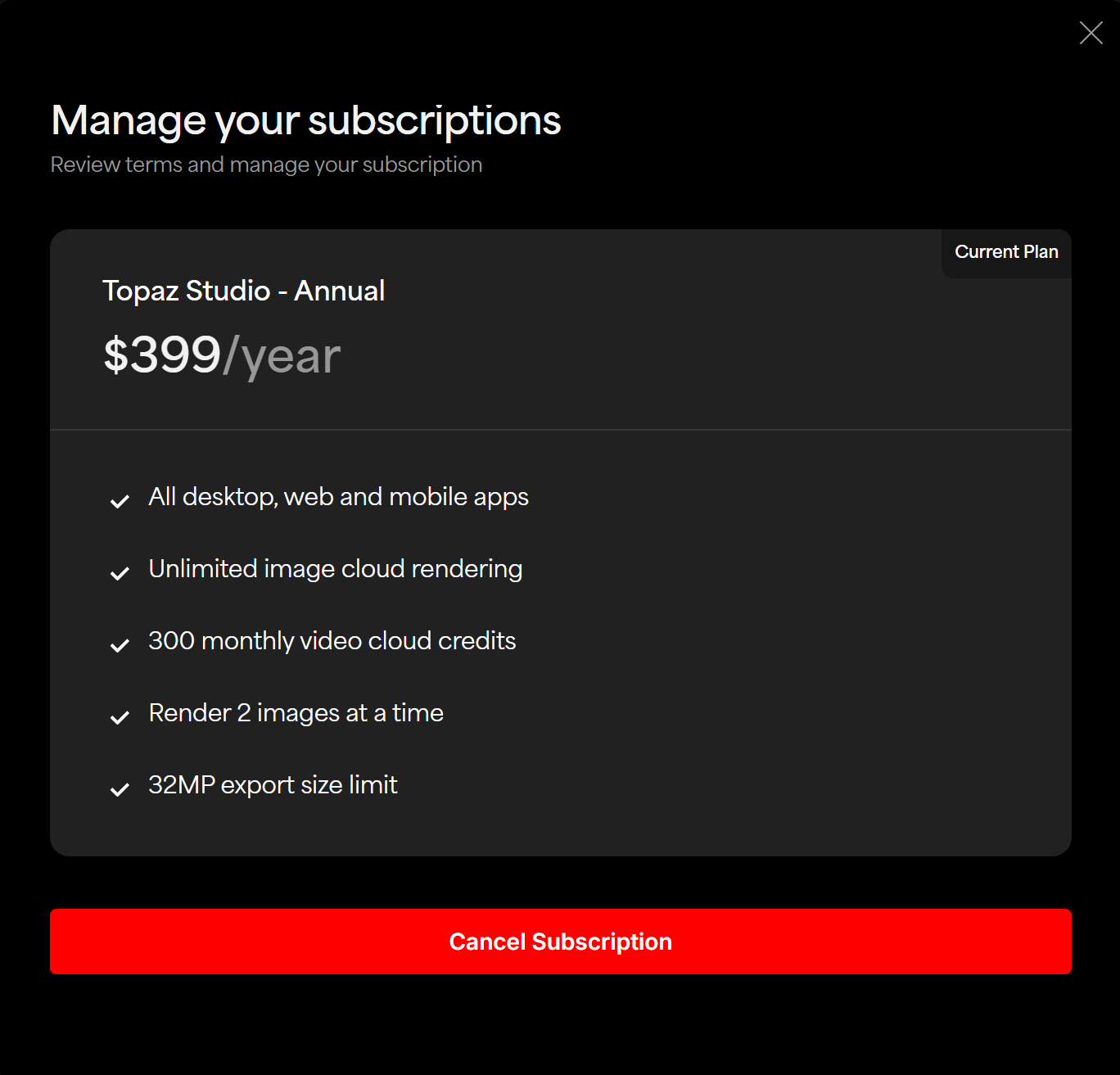
My account also finished the transition. However, when I click the “Manage” button for the Topaz Studio subscription, it says my renewal price is $399.
To be honest I’m not going to worry about whether Topaz will reduce or remove the discount, enough things to worry about with this whole situation as it is.
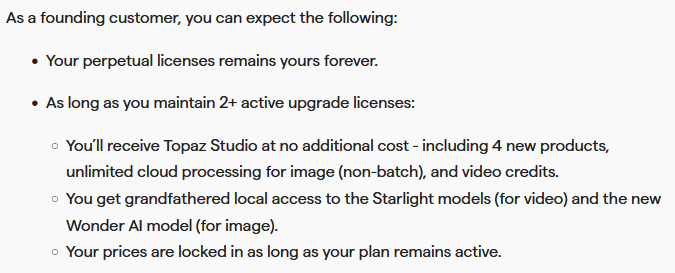
The Topaz CEO gave his word that the price will be locked in as long as the plan remains active and AND-E confirmed the same:
My “new” dashboard makes no mention of transition having been completed and indicates I have no subscriptions. I have to go to the original one to see the correct information.
Interestingly, although my GPAi expires this December, I am not expected to cough up the $163 until next August when PAI expires. So presumably I can continue to use Gigapixel until then.
Just checking now to see if my Gigapixel iOS app has updated to unlimited cloud renders (not that I have any practical use for it).
Looks like my account has mostly(?) transitioned to Studio. It does show my next renewal as the later of my two active subscriptions. Price shows $399 but I expect that to adjust to $163.
Biggest remaining question… I now have 3,620 credits in my account, previously I had 20 of unknown origin. How long are these 3,620 available for? I understood previously that the 300 monthly studio credits expire each month. I sure wish you could accumulate them!
So I guess they gave me (+others?) a year’s worth of credits as a Founder’s gift?