I hope users and developers can find the problem and solve it. While I didn’t experience it myself, I trust others have and based on the description it does seem like the program is not delivering for some on what is promised.
But I am happy because the scroll-zoom appeared.
Considering the nature of your complain I am very confused by this sentence. How can you be so vocally unhappy with preview, but then be happy with AI based zoom in non integer steps (multiples of 100%)? Zoomed preview is far more removed (aka different) from the actual output file than 100% preview.
1 Like
This is correct as previews are always a sticking point because a high-res preview will take as long to process as the actual output would because it would need to process the whole image.
2 Likes
What Eric wrote I already knew. For me, this is obvious as the words of Captain Obvious. But I proposed a solution on how to get the result identical or comparable with the preview for the whole picture of any size. And the trouble is that they ignore me.
So Eric say it’s not a problem. And will be not fixed. But i see with my eyes the preview much more quality than final image. The settings of the image is useless now, because the preview not shows the final quality. It’s different on each zoom size mode.You will don’t know how’s the final image look like. Interesting. That’s not good.
If you used all or any of the programs from Topaz Labs, you would know that they have a different interface, not unified. And it’s very bad. Topaz Studio had the most thoughtful interface, and I asked to be guided by it in design, as well as add more mouse control, for example, for sliders. They started with a smooth zoom. He is not yet as good as in the studio, or in Photoshop, but I hope they lead programs to a common style.
Personally I am waiting for undo/redo. Zoom at non integer levels using AI processing is mostly useless for assessing image output anyway, so the wheel zoom is more of a gimmick that is too easily activated accidentally. CTRL + wheel would be a better choice, because it is a widely used shortcut (browsers, Lightroom and I even changed my PS to use that) and less easily used unintentionally.
This is normally implemented in the studio. You must require the standardization of interfaces from developers.
But, could you explain where and what are you want to cancel with using the Undo function?
In my country, they usually rhetorically ask: Why does a goat need an accordion?
But, could you explain where and what are you want to cancel with using the Undo function?
Slider changes. Preview renderings are cached so doing a undo/redo is a quick and easy way to compare two different slider settings via keyboard short-cuts. Giving how finicky the sliders are it’s also an easier way to reset a single slider to its last/default value.
Works great in Sharpen and Denoise, even doing multiple steps.
The problem I have with their explanation is even on v5.1.6, you get a sharper/more focused upscale from plain CPU vs OpenVINO accelerated or GPU. Its much closer to the preview on images where the preview is sharp and the upscale is not.
Surely if the AI models are the same, the result shouldn’t differ depending on what hardware you use to get to that result?
Gigapixel Ai is an expensive tool to be asking so much from its users…why am I struggling to solve what is clearly a production problem…my windows pc meets all the requirements, according to Topaz’ s own guidlines for what should be trouble free use. The other products like Denoise, and Adjust are near perfect in performance…but I refuse to spend time every day trying to figure out why Gigapixel doesn’t work…if it’s not crashing after only getting to a 3% completion phase it stalls at the time of saving…I will be broadcasting to all my photographer friends not to put there money into it until the program is ready for Prime Time:(
Please go to Help-> Graphics info and press Copy then post there info here. At the same time list what the Advanced Preferences are.
Note: you should go to your profile and remove your email from your name field as this is a public forum and anyone can see it.
The program is currently essentially useless for processing large images. You spend time to tune in the preview and then the results have nothing to do with it. The only way currently to get a decent result on enlarging an already large image is to do it in pieces. The last one I did I had to do as screenshots, piece by piece, combined in photoshop into a final image.
I should note that now the increase x2 in the preview is almost identical to the result file x2, you can already work with it. x4 and more not work fine yet. For myself, I decided not to try to face the wall of misunderstanding anymore, communicating with managers and rarely occasionally with developers. What they have achieved with x2 is quite enough for work.
Of course, I’m glad that they even listened to my opinion about the sliders and now they interact with the scrolling of the mouse, it became more convenient to work, but even adding such a trifle took an incredible amount of time.
Period my updates of several programs, suddenly for me, came to an end, so I will not even try to push further updates and improvements to the program. Perhaps I will update with a significant leap in the quality of processing, but in my humble opinion, this is not feasible in the next three years.
Topaz Labs has only data-depleting AI for now. They are not able to increase the amount of detail infinitely. With each processing, my uncompressed TIFF files only decrease in size but should grow.
If I manage to find a program capable of restoring data on an image, restoring gradients and textures, then this would allow me to continue enlarging the picture, or perform other operations with it in other Topaz Labs programs.
1 Like
In my case, there is almost no difference between the original image and the AI enhanced one. I’m trying to improve the resolution of the black and white screen grabs of public domain horror movies. The preview is not much different that the output. Is there a limitation of what the AI can do with black and white photos? Or maybe there’s something I’m doing wrong. I’ve played with the settings and it doesn’t make any differences at all.
Edit: I found the solution: I have to make my images much smaller to make it works. Then, I can increase the image size y 4 or 6 times and I have a significant improvement in image quality.
I wrote about this in the summer here:
https://community.topazlabs.com/t/gigapixel-v5-0-0/15342/64
But nobody understood to me that this is a bug that the developers should fix. I even made a separate button in the interface design to solve this bug.
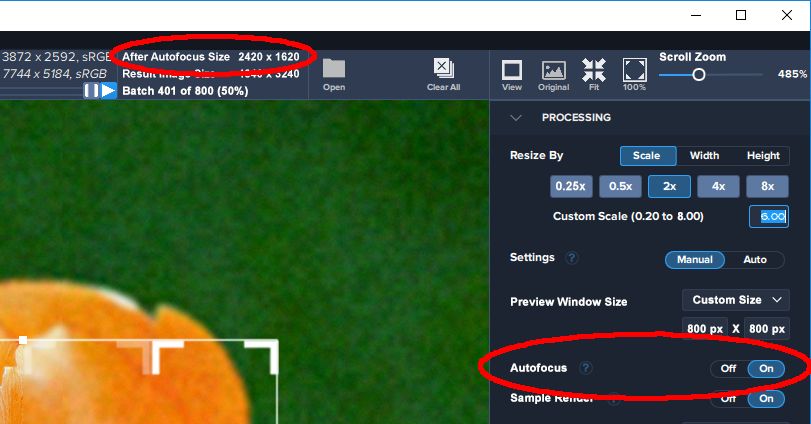
I will copy part of the post to this topic:
Only developers know what resolution the incoming image must-have for the algorithm to recognize it as satisfactory and adequately increase it.
If you plunge into history, Bayer filters, and the like, it turns out that the actual resolution of the incoming image is much less than you think. Therefore, a blurred image stretched by the camera, and the algorithm cannot swallow such a soapy picture.
If you can reduce the image to real resolution, where each pixel carries real information, the algorithm will work much better.
1 Like
