I currently have a 5070 and use Starlight Mini mostly for some of my old SD videos. As you know, SM is very slow and I’m wondering if I would see a speed benefit with a 4080 Super? I know this is a better gaming card, but it’s also a year or so older - would this affect its AI performance, specifically with Starlight Mini? Any advice would be greatly appreciated!
The 4080 will have more VRAM and faster rasterization in gaming, but the 5070 has better power efficiency and modern architecture. With models like Starlight Mini, VRAM is key for the heavy lifting, but the margin of increase could be subtle when looking at these two cards.
Are you running this in the new app Topaz Video or in the older app Video AI? There are some performance increases in the newer releases of Topaz Video that could already make up the difference between these two cards.
I’m using the newer Topaz Video
The 4080 Super could provide a little extra boost but not sure on the exact increase in processing speed you would see and if it would be worth the cost. Depending on the resolution of the source file and the amount of upscaling it could be minimal but the team is working on some further improvements to be made in upcoming releases that should help.
I would be reluctant to buy an Ada series GPU now. With a compute capability of 8.9, they’re now the minimum required to run all the Starlight models, while the 5xxx series cards are 12.0. How long will it be before 8.9 is no longer enough?
I’m trying to make a similar decision between the 5060, 5070, and 5080. One thing that’s making it harder is that almost all reported benchmarks for Starlight Mini on NVIDIA show an “error” or failed run. Topaz Video 1.6.x - user benchmarking results
Based on what people have shared so far, here’s my working theory:
Starlight performance might scale primarily with L2 cache size, which would explain why older NVIDIA cards — and AMD cards — don’t perform well in Starlight Mini. There’s also a post from a 4090 owner and a 5090 owner saying their Starlight results were extremely similar, which lines up with the idea that raw rasterization performance doesn’t matter much for this model.
If this theory is correct, then Starlight (at least the current version) doesn’t scale with traditional GPU performance metrics. Instead, it scales with specific architectural traits like L2 cache.
For example:
-
The 4070 and 5070 have identical L2 cache sizes, so in theory their Starlight performance should be the same.
-
The 4080 and 5080 also share the same L2 cache size, so their Starlight results might match as well.
If you want to trust my theory, I’m assuming a 4080 Super or 5080 won’t be much faster than what you currently have. But if you were to jump to a 5090, you might be cutting your rendering times in half. Again, that’s only under the assumption that Starlight is bottlenecked by L2 cache and not raw compute..
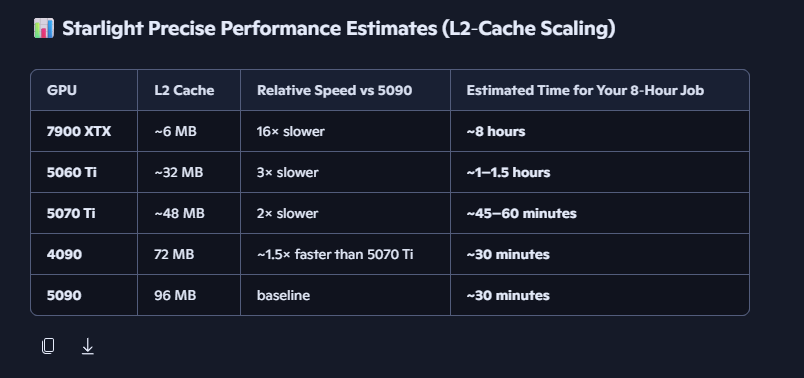
And honestly, if you think your 5070 feels slow, you should see how bad AMD users have it right now on Starlight. The difference between NVIDIA and AMD on this model is almost extreme — it’s one of the clearest performance gaps I’ve ever seen in Topaz. That’s another reason I suspect Starlight is hitting architectural bottlenecks rather than traditional GPU throughput.
This isn’t scientific — it’s just an estimate based on user‑reported results in this community, assuming their test sources are comparable. It also assumes my L2‑cache theory is correct for Starlight. And all of this could change drastically if Topaz optimizes Starlight in future updates
It does that on my RTX Pro 4000 even though the model works just fine on actual clips. I think that’s mainly a problem with the benchmark.
I agree, the SL Mini Benchmark has been broken for a long time now.
So do you think I would get much improvement from a 5070ti compared with my 5070? 16GB instead of 12GB? Can’t afford a 5080 unfortunately.
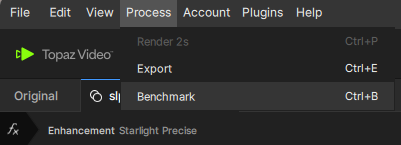
The VRAM topic is a tough one. In raw rasterization, the 5070 Ti should perform slightly better than the 5070 simply because it has both higher core counts and more VRAM. There are plenty of 5070 Ti benchmarks available, so you can compare them directly by hitting this button:
As for Starlight performance, it’s harder to predict. Starlight seems to be either still undergoing optimization, or its performance may depend more on L2 cache behavior than raw compute. If that’s the case, the 5070 and 5070 Ti might end up performing very similarly in Starlight despite the VRAM difference.
As I mentioned earlier, if Starlight’s performance is tied to the unique feature that both the 4000‑series and 5000‑series NVIDIAs share — their massive L2 caches — then the difference between a 4080 Super and a 5080 wouldn’t matter much either. Both of those cards have significantly larger L2 caches compared to something like a 3090 Ti or an AMD card, so their Starlight performance may end up being nearly identical.
Thank you to everyone who has taken the time to reply. Really appreciate it. I have gone for a 5070 ti which was selling at a good price. I’ll see if I get any improvement!
